
Checking Criminal History in Cumberland County
No single Cumberland County search answers every record question. Start with the event and the likely custodian. A municipal complaint may appear in Municipal Court Case Search, while an indictable charge belongs in the Superior Court Criminal Part and PROMIS/Gavel. The county jail lookup answers current custody, not a final result. A person reviewing their own statewide record should use the New Jersey State Police fingerprint process. This split matters because an arrest report, a booking entry, a case file, and an SBI history can describe the same event at different stages.
The official Cumberland County directory is the sound starting point for county departments and current contact paths.
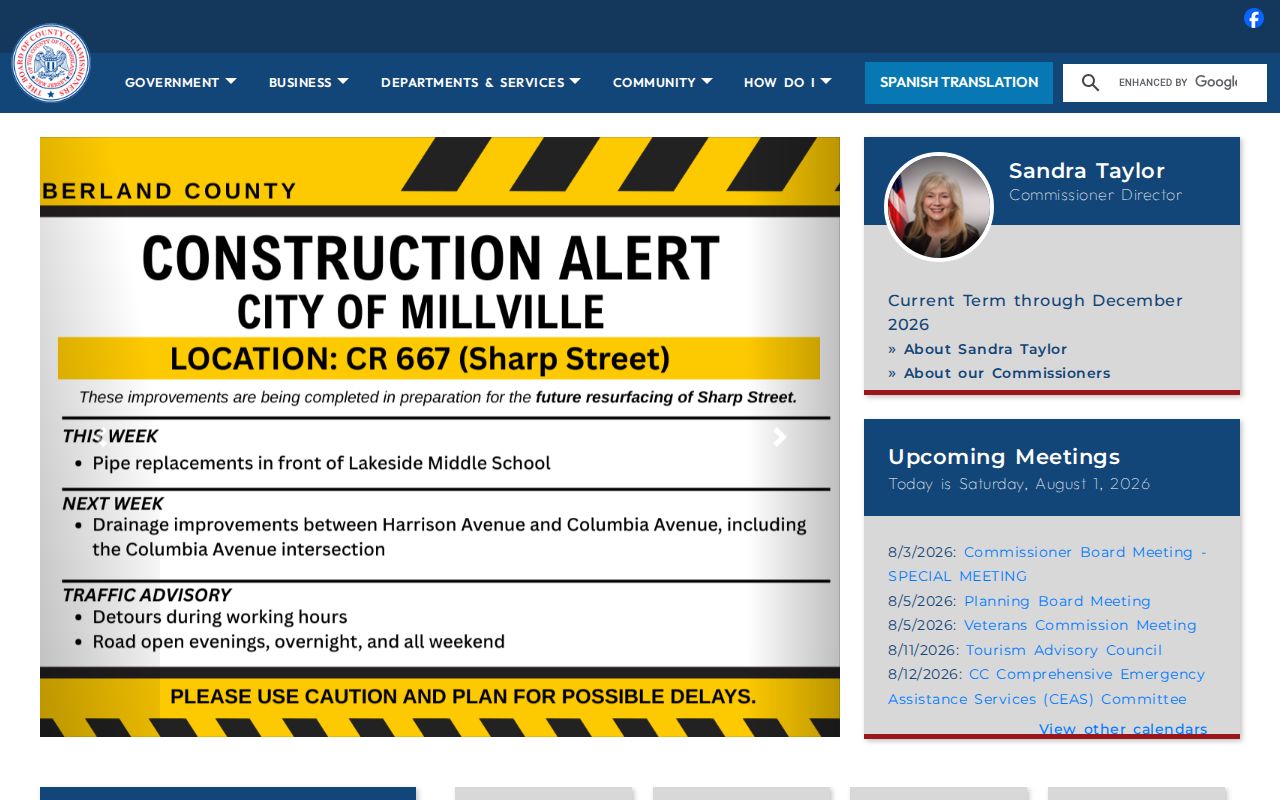
The directory helps keep a county OPRA request with the correct department instead of sending a court request to an executive-branch custodian.
- Identify whether the needed fact is an arrest, current custody, court outcome, or statewide personal history.
- Gather the legal name, spelling variants, date of birth, event date, location, and any complaint or docket number.
- Search the matching official system, then confirm that the court, county, and identifying details fit.
- Ask the arresting agency or court for the underlying report, order, or judgment when a summary is not enough.
- Use a certified court copy or fingerprint-supported personal review when the purpose calls for an official record.
Cumberland Criminal Records Span Four Systems
Cumberland criminal records commonly live in four distinct systems. Police agencies keep incident and arrest narratives. Cumberland Corrections creates the booking and custody file. New Jersey courts keep complaints, motions, pleas, orders, and dispositions. NJSP SBI maintains fingerprint-linked arrest cycles and reported outcomes. A person can therefore find a police report without a court result, or a resolved court case whose final disposition has not yet matched the repository entry.
| Question | Best first channel | What it does not prove |
|---|---|---|
| What did police report? | Arresting agency records unit | Final charge or guilt |
| Is the person in county custody? | Cumberland Corrections lookup or contact | Conviction or sentence |
| How did the charge end? | Municipal or Superior Court file | Complete statewide history |
| What is tied to my fingerprints? | NJSP personal record review | Every pleading or police narrative |
When two sources disagree, compare the court judgment with the arrest cycle and ask the office that owns the incorrect entry about its correction path.
New Jersey Official Background Checks
The New Jersey State Police State Bureau of Identification is the central criminal-history repository. Its 212B Name Check is a consent-based product for qualified statutory purposes. It is not an unrestricted public people search and is not the route for checking oneself. A standard request costs $20, while a qualifying volunteer request costs $12. The subject generally has seven days to approve the request. Without approval, the transaction expires.
The official 212B request screen shows the qualified-purpose and requester workflow used by SBI.
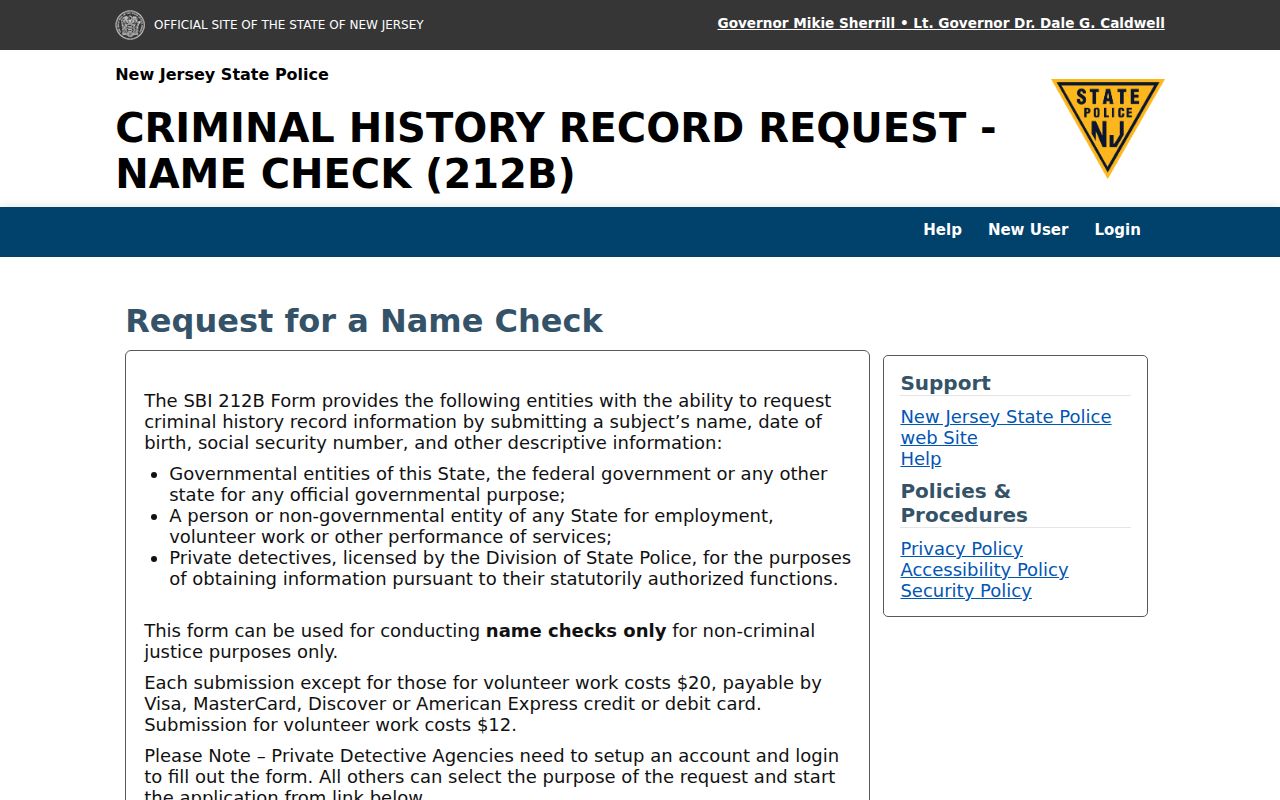
Its consent controls are a useful reminder that New Jersey has not opened its repository as an anonymous Cumberland County name-search service.
| Official service | Main use | Core requirement |
|---|---|---|
| NJSP 212B | Qualified name-based request | Authorized purpose and subject approval |
| NJSP Personal Record Request | Reviewing one’s own New Jersey history | Fingerprints through IdentoGO |
| FBI Identity History Summary | Reviewing one’s own national repository history | Fingerprints and FBI submission |
Cumberland Criminal Records on Broad Street
Bridgeton’s justice offices are close together but remain separate custodians. The Cumberland County Courthouse at 60 West Broad Street holds Superior Court criminal functions. Cumberland Corrections and the jail are at 54 West Broad Street. The county administration and OPRA counter are at 164 West Broad Street. The Prosecutor’s Office is nearby on Vine Street, while the Sheriff’s Office operates from North Laurel Street. Proximity does not merge their databases or legal duties.
Criminal Division
60 W. Broad St.
Bridgeton, NJ 08302
856-878-5050
County Custodian
164 W. Broad St.
Bridgeton, NJ 08302
856-453-2165
Cumberland Corrections
54 W. Broad St.
Bridgeton, NJ 08302
856-453-2125
The layout explains a common records mistake: the prosecutor screens indictable charges, but the Judiciary, not the prosecutor, is the custodian for a public court-file copy.
The county’s official sheriff and jail history traces how Cumberland’s justice facilities moved and expanded from the first county jail.
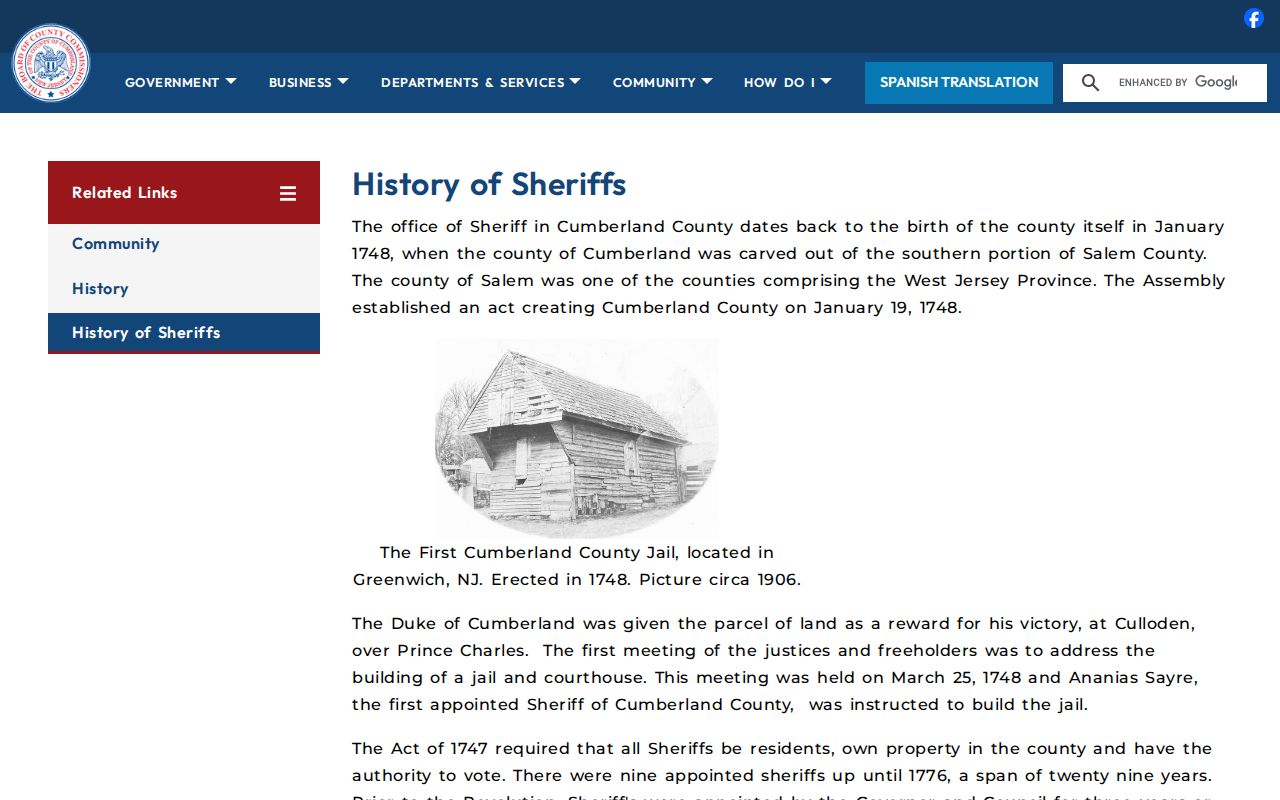
That institutional history helps explain why today’s court, corrections, prosecutor, administration, and sheriff records sit in related but separate offices.
Criminal Record Types
Cumberland County criminal records are defined by who creates them and when. An incident or arrest report captures police response and allegations. A booking file documents jail intake, biometrics, initial charges, bail, and custody. A court case file records what prosecutors filed and what the judge decided. An SBI history links fingerprint-supported arrest cycles to reported dispositions. Warrants and supervision records have their own custodians and access limits.
- Police report: request it from the sheriff or municipal police department that handled the event.
- Booking record: use Cumberland Corrections for intake, county number, custody, or release information.
- Court file: use the municipal court for lower offenses or Superior Court for indictable crimes.
- Rap sheet: obtain one’s own fingerprint-linked New Jersey history through NJSP.
- Registry record: use the official NJSP public registry within its stated coverage limits.
New Jersey calls serious offenses first- through fourth-degree crimes. Lower Title 2C offenses are disorderly persons or petty disorderly persons offenses, not statutory misdemeanors.
Cumberland Criminal Records Through OPRA
Cumberland County accepts executive-branch requests through its OPRA portal, by mail, by fax, or at the County Administration Building counter. A strong request names the department, record type, date range, location, incident or case number if known, and preferred delivery method. OPRA reaches identifiable existing records. It does not require staff to answer a research question or make a new compilation. Court records follow Judiciary procedure and Court Rule 1:38 instead.
The county’s OPRA instructions and request portal show the online and paper routes available to a Cumberland records requester.
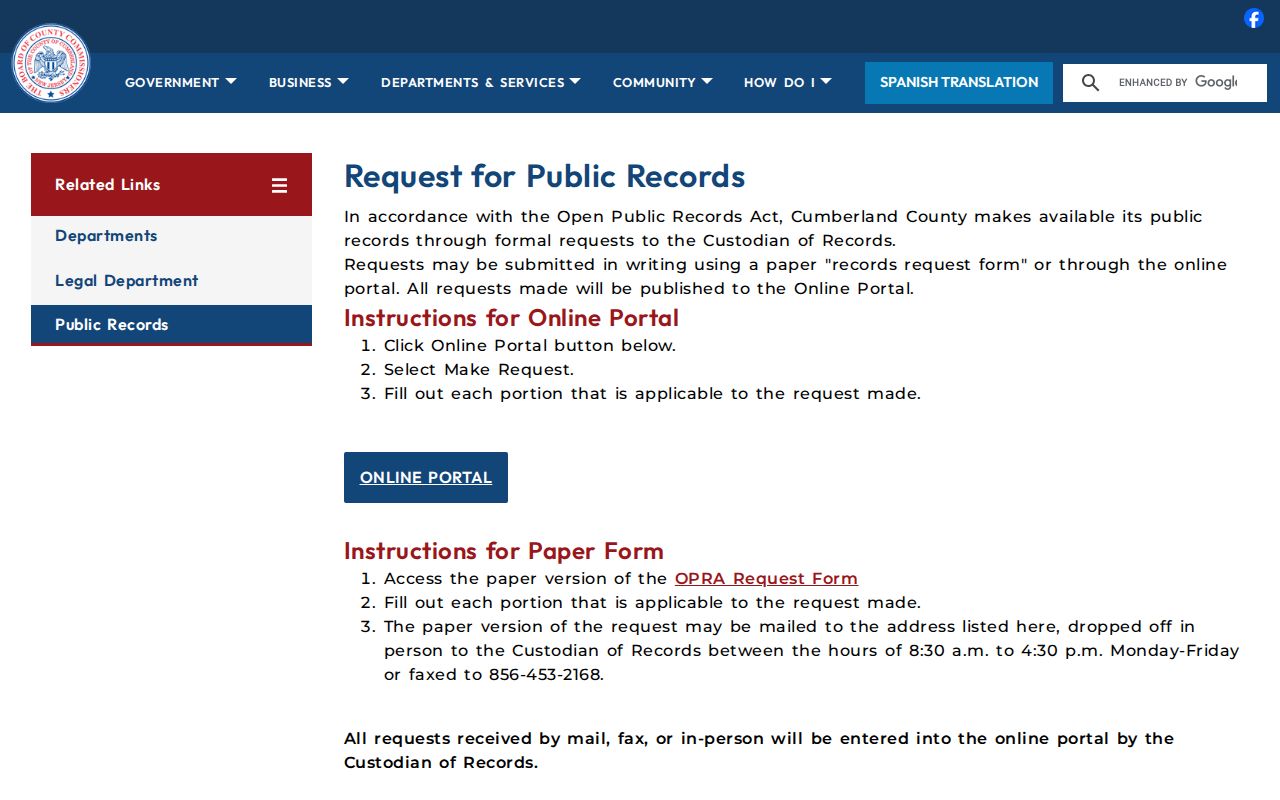
Paper, fax, and walk-in submissions are entered into the county portal, so a precise description remains useful in every delivery channel.
| Form field | Why it matters |
|---|---|
| Agency or department | Routes the request to Sheriff, Corrections, Prosecutor, or another custodian |
| Record description | Names an existing report or file rather than posing a question |
| Date range and event place | Narrows the search and reduces mistaken matches |
| Delivery and fee authorization | States how copies should arrive and how approved costs are handled |
Ordinary copies generally cost $0.05 per letter-size page and $0.07 per legal-size page unless another law sets the charge. Extraordinary service costs can apply.
The MyCumberland mobile app can submit and track county OPRA or service requests, attach files, search request types, and display county contacts. It is a request-tracking convenience, not an inmate lookup, warrant search, or criminal-history database. That limit matters when a reader sees the app beside other county services.
Inside a Cumberland County Criminal Record
A record should be read count by count and source by source. Names and aliases help identify the subject, but a date of birth or docket number is often needed to avoid a same-name error. An initial charge may later be amended, dismissed, remanded, no-billed, or resolved by plea or trial. The disposition is the outcome. The sentence may add custody, probation, fines, restitution, or other terms.
| Name and identifiers | Public name, aliases, case number, complaint number, county number, or SBI number as the source permits |
|---|---|
| Arrest and booking | Agency, date, intake time, initial charge, bail, and custody status |
| Charges | Offense text, N.J.S.A. citation, degree, and count |
| Disposition | Guilty, dismissed, acquitted, diversion, no bill, or another recorded outcome |
| Sentence | Custody term, probation, financial assessments, credits, and concurrent or consecutive treatment |
| Restrictions | Protected identifiers, juvenile data, victim details, sealed material, and expunged records are withheld |
Note: A charge label describes an allegation or filed count; only the final disposition shows how that count ended.
Cumberland Booking Records Reach NJSP
When Cumberland Corrections accepts a custodial commitment, staff verify legal authority, establish a county number, and record the initial charge and custody data. Live Scan fingerprints and palm prints establish or match the SBI number. The fingerprint transaction updates New Jersey Computerized Criminal History and also travels to the FBI’s identification system. Courts and prosecutors later report dispositions back toward SBI.
The NJSP Identification and Information Technology section describes the state systems that receive Cumberland criminal-history events.
This chain explains why fingerprints are more reliable than a spelling-only match, yet a lagging disposition can still make a repository cycle incomplete.
Record flow: Arresting agency › Cumberland Corrections Live Scan › NJSP SBI › court disposition reporting.
Public Access Laws in New Jersey
Public access depends on the record’s custodian. OPRA applies to county and city executive records, subject to exemptions. Court Rule 1:38 governs Judiciary files. Separate statutes control SBI dissemination, expungement, and the Megan’s Law Internet registry. A public court disposition can remain available even when parts of a police narrative are withheld for an active investigation or to protect victims and personal identifiers.
Key laws:
N.J.S.A. 47:1A-1 through -13 creates OPRA access subject to statutory exemptions.
New Jersey Court Rule 1:38 sets the access and redaction rules for court records.
N.J.S.A. 53:1-20.5 and 53:1-20.6 restrict dissemination of State Police criminal-history information.
N.J.S.A. 2C:52-1 et seq. governs expungement and access after relief.
N.J.S.A. 2C:7-12 through -19 controls public Internet registry information and its lawful use.
Ask for segregable public portions when a full report contains protected material. A denial or unfilled county OPRA request may be challenged through the Government Records Council or Superior Court under the applicable process.
Cumberland Police Records Stay Local
Police reports remain with the agency that created them. A Vineland event belongs with Vineland Police, a Millville report with Millville Police, and a Bridgeton report with Bridgeton Police. Sheriff records use the county route, while trooper records use NJSP channels. Give the incident number, date and time, location, involved-party name, and exact record or media requested. Asking the courthouse for a police narrative usually sends the search to the wrong custodian.
The NJSP Criminal Justice Records Bureau publishes the state police records contact path. NJSP crash reports use a separate official portal. City and county requests follow their own OPRA processes. An incident report explains police response; an arrest file documents enforcement and intake; a court case records prosecution and outcome. One Cumberland event can create all three without making the documents interchangeable.
Active investigations and protected victim, juvenile, medical, address, and identifier data may be withheld. A focused request for the segregable public portion is more effective than a demand for an unredacted complete file.
Cumberland Jail Records Have Clear Limits
The Cumberland Corrections incarcerated-person lookup is a current-custody and recent-booking channel. It is not a countywide conviction index. A missing name can mean release, transfer, alternate spelling, delayed indexing, or custody elsewhere. For details that the lookup does not show, contact Cumberland Corrections or seek an identifiable booking record through county OPRA.
The county’s incarcerated-person services page points readers to Cumberland’s custody lookup and service contacts.
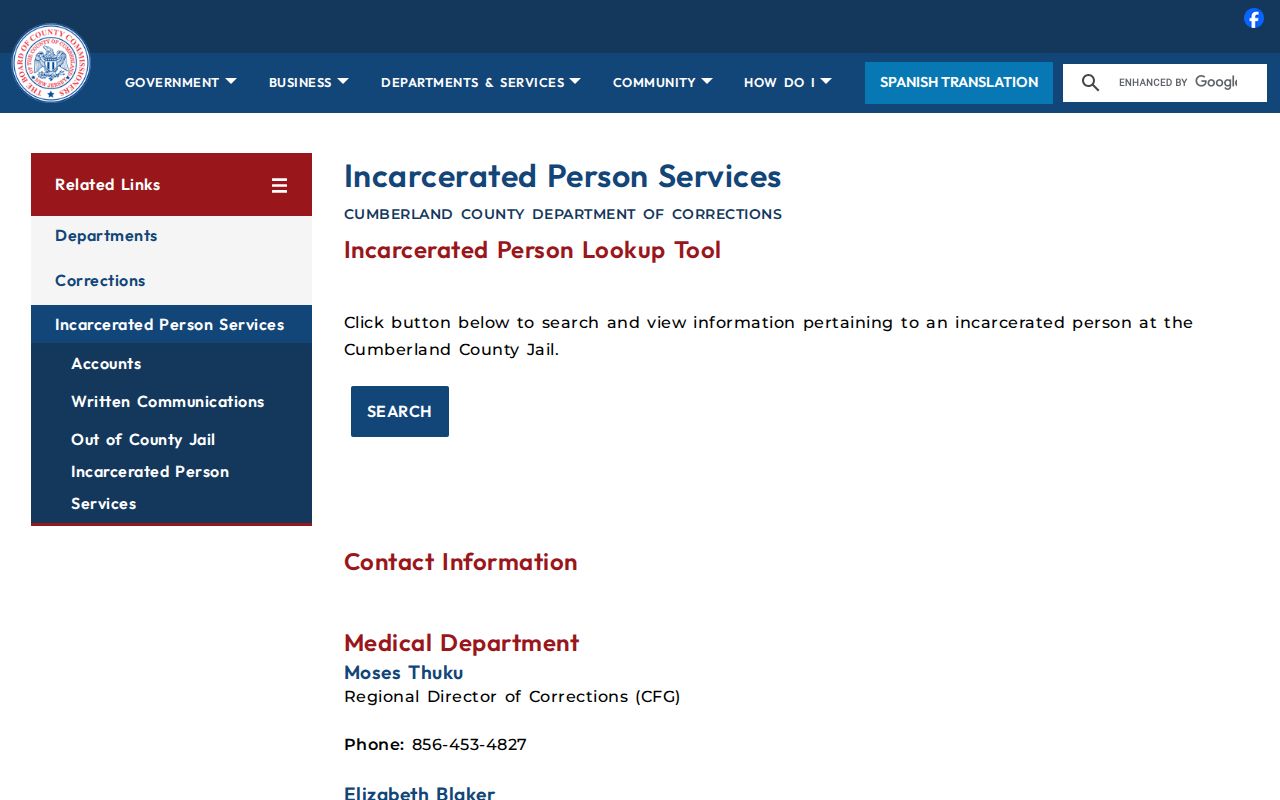
The result should be paired with the court disposition because booking proves intake, not guilt or the final charge.
After a state sentence and transfer, use the NJDOC Offender Search Engine rather than the county roster.
NJDOC covers the sentenced state population and should not be read as a substitute for Cumberland County pretrial custody data.
Cumberland Warrant and Supervision Records
No current official Cumberland-wide warrant database was found. A municipal bench warrant should be checked with the issuing municipal court, while Superior Court case context belongs with the Criminal Records Room. Sheriff-held information can be checked at 856-451-4449, and an identifiable non-exempt county record can be requested through OPRA. Do not treat an old most-wanted release or an empty search as live clearance. A person resolving their own warrant should confirm the issuing venue, obtain the complaint number, learn the required appearance or surrender process, and keep written recall or disposition proof.
Probation and parole are also separate. New Jersey Judiciary Probation serves Cumberland through Vicinage 15, and the court judgment shows a sentence to probation. The New Jersey State Parole Board handles parole after state imprisonment, while NJDOC search can show available sentence and parole-eligibility fields. Detailed supervision conditions and violation histories may be restricted. NJ VINE supplies custody and release notifications but does not replace a court or parole record.
Note: Cumberland Corrections runs another warrant check before release, so satisfying bail in one matter may not clear a separate valid hold.
Sealed, Expunged, and Restricted Records
New Jersey expungement generally isolates qualifying records from ordinary public access. It does not promise literal deletion from every system or bar all authorized criminal-justice use. Ordinary, early-pathway, clean-slate, recovery-court, non-conviction, diversion, and marijuana-related paths have different rules. Eligibility can turn on the offenses, the number of matters, and time measured from the latest qualifying conviction, payment, supervision completion, or release.
A self-represented filer can use the Judiciary’s electronic expungement system. Build a complete list of arrests, complaint and docket numbers, courts, dispositions, and completion dates first. The Cumberland Criminal Division Expungement Clerk is at the county courthouse and can be reached through 856-878-5050 extension 15492. Under a 2025 law, the county prosecutor must provide available county case-management charge and conviction information on request to help prepare a petition.
The New Jersey Judiciary’s marijuana expungement report documents more than 362,000 qualifying cases cleared through the statewide automatic process. A person who believes a Cumberland case was missed can seek judicial review.
Cumberland Criminal Cases Use Degrees
New Jersey does not label its main offense levels as felony and misdemeanor classes. Indictable crimes run from first degree through fourth degree. Disorderly persons and petty disorderly persons offenses are normally heard in municipal court. Degree describes the charge level, not what ultimately happened. Always place it beside the disposition and sentence.
- Disposition
- The recorded outcome of a count, such as guilty, dismissed, acquitted, or diverted.
- No bill
- A grand jury did not return an indictment on the presented charge.
- Remand
- An appropriate matter moves from the indictable track to municipal court.
- PTI
- Pretrial Intervention is a supervised diversion path that may end in dismissal after successful completion.
- Docket number
- The Judiciary identifier used to locate the filed Cumberland case.
A first-degree crime normally carries the highest ordinary range, while a petty disorderly persons offense carries the lowest. Offense-specific laws can change fines, minimum terms, and eligibility, so the judgment remains the best source for the actual result.
No Cumberland Record Result Is Conclusive
An empty search result has a limited meaning. Municipal Court Case Search will not expose every indictable case. A conviction-only screen can omit a pending or dismissed count. A county jail lookup can lose the trail after release or transfer. The public sex offender registry does not publish every registrant because New Jersey uses risk-based notification rules. Even an SBI record can await a disposition match.
The official IdentoGO enrollment service is the fingerprint channel for a New Jersey personal record review.
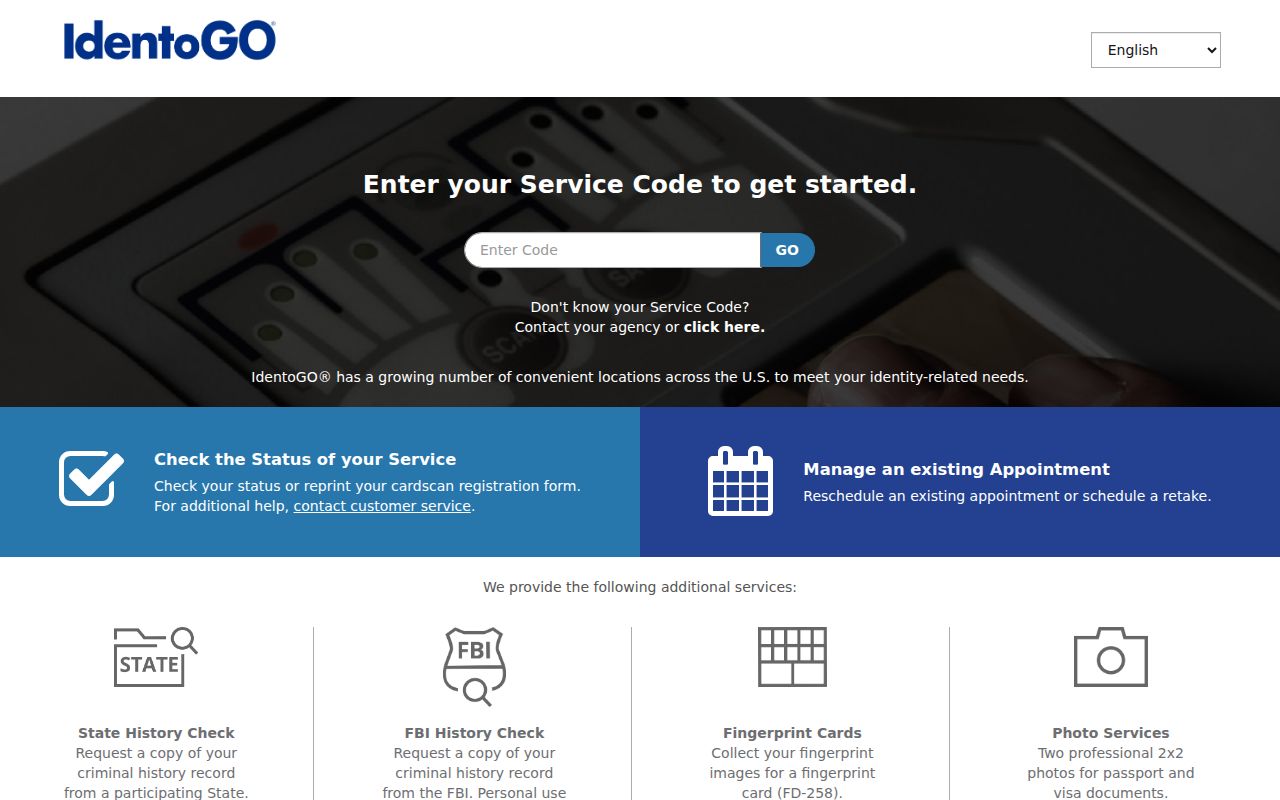
Applicants need the correct New Jersey service code and valid photo identification; a wrong service code can route the result into the wrong program.
Match the source to the question. “No result” means only that the chosen system did not return a public match under the terms entered.
Cumberland County Criminal Records by City
Vineland, Bridgeton, and Millville police departments create their own incident and arrest reports, and each city has a municipal court route. A city search therefore starts with the local custodian before it moves to Cumberland Corrections, Superior Court, or NJSP. The 2025 Census estimates rank Vineland first, Bridgeton second, and Millville third among incorporated cities in Cumberland County.
Vineland Criminal Records
62,703 residents · VPD records, NextRequest, and Court ID 0614
Bridgeton Criminal Records
28,307 residents · police and joint municipal court at Fayette Street
Millville Criminal Records
28,098 residents · FormCenter requests and Court ID 0610
Each local page keeps city police and municipal court channels in focus while routing county custody and indictable matters to the proper Cumberland County office.